Service Dog Training

Service dogs, trained to the person who needs them

Canines 4 Hope provides trained service dogs for people with limitations that require a dog to help with everyday tasks, early warning situations or companionship. Every program is customized, and every dog is trained to its handler's own medical needs.

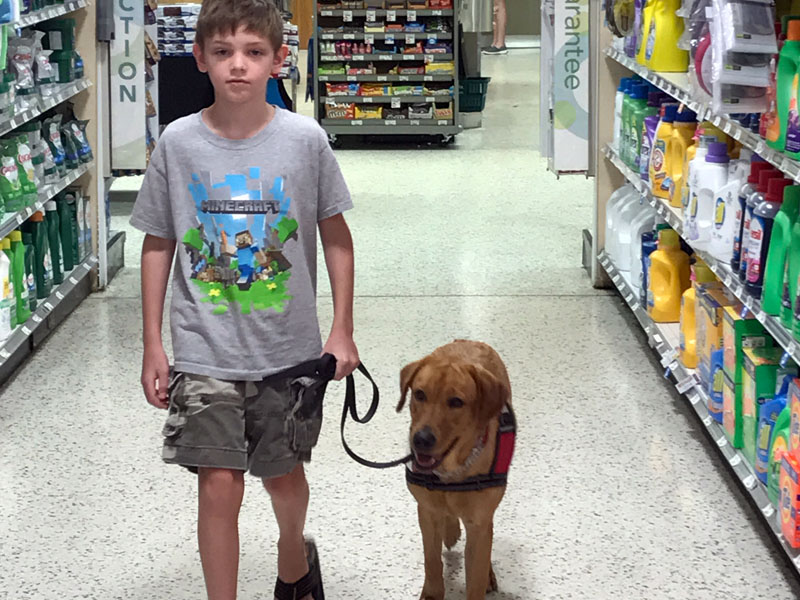
A boy in a grey T-shirt stands in a supermarket cleaning products aisle holding the leash of a tan dog in a red and black service harness standing at his side.

Certified service dog training

One dog, one handler, one customized program

Canines 4 Hope's goal is to provide you or your family with a trained service dog that will take care of the needed tasks required for living a fulfilled life.

Customized service dog training programs cover the two sides of the work: service dogs, trained to retrieve medication, open doors and alert authorities, and assistance dogs, trained to provide wheelchair assistance or stability. Alert dog training runs alongside both, so a single dog can be taught to recognize and respond to seizures, panic attacks and blood sugar fluctuations.

Service dogs, assistance dogs and alert dogs can make life easier for people living with diabetes, epilepsy or seizure disorders, autism, stability limitations, post traumatic stress disorder and psychiatric conditions. Service dogs, alert dogs and assistance dogs are available to clients nationwide.

Conditions these dogs help with

  • Diabetes
  • Epilepsy or seizure disorders
  • Autism
  • Stability
  • Post Traumatic Stress Disorder
  • Psychiatric disorders

Psychiatric disorders named on our list: major depression, obsessive compulsive disorder, ADHD, bipolar assistance, panic attacks, anxiety, social phobia, Alzheimer's, dementia, schizophrenia.

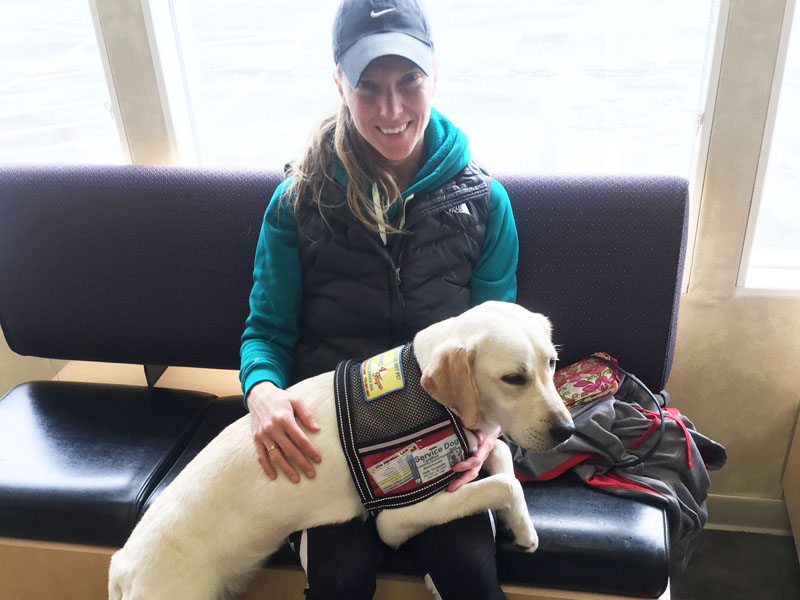
A woman in a cap sits on a bench in a waiting area with a yellow dog in a patched Service Dog vest resting across her lap.
A trained service dog goes where its handler goes, including airplanes, restaurants, the supermarket, and hospitals.

No Long Waiting Lists!

Canines 4 Hope offers pre-trained service dogs, alert dogs and assistance dogs that can be tailor trained to your specific needs in 3 to 6 months. There are not-for-profit programs available, but most of these wonderful organizations have a waiting list for up to 3 years. If you or someone you love just cannot wait that long, give us a call.

1-855-885-6262

Service dogs, basic tasks

What a service dog can be trained to do

A service dog helps individuals with limitations live a normal life with a sense of independence they deserve. Whether the need is an everyday task, an early warning situation or companionship, service dogs can accomplish these basic tasks.

  • Retrieve medication and other items
  • Open doors and cabinets
  • Pick up phone
  • Alert authorities
  • Turn on and off lights
  • Alert owner to seizures
  • Alert owner to changes in blood sugar
  • Find keys
  • Take off shoes and socks
  • Carry groceries or laundry
  • Assist with walking
  • Alert owner to sounds (doorbell, phone, etc)
  • Pick up mail
  • Provide companionship

The tasks above represent what a service dog is capable of performing. Each service dog is specifically trained to its owner's personal needs based on their medical condition, and may or may not include the tasks described above.

Canines 4 Hope's goal is to help take some of the burden off care takers, and help individuals with medical or physical limitations have a richer and easier life.

Serving the Disabled One Paw At A Time

The mission of Canines 4 Hope is to provide you and your family with assistance and hope to live a fulfilled and fruitful life with the aid of a professionally trained service dog.

Specialty service dogs

Every specialty, and what each dog is taught

Specialty service dogs include PTSD dogs, psychiatric service dogs and autism service dogs, alongside wheelchair and stability assistance dogs. Each list below is a set of examples, not a fixed curriculum.

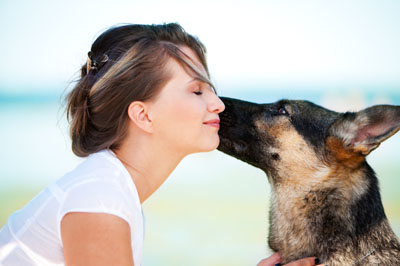
A woman with her eyes closed and a smile on her face as a German Shepherd licks her cheek, photographed outdoors against a pale sky.

PTSD Service Dogs

A PTSD service dog is a dog that is specifically trained to service and assist people with post traumatic stress disorder and other mental illnesses including anxiety and depression, which can be triggered because of a traumatic event that has occurred in someone's life.

PTSD dogs are trained to

  • Assist in a medical crisis
  • Provide treatment related assistance
  • Assist in coping with episodes of panic and anxiety attacks and emotional overload
  • Perform security enhancement tasks

Tasks a PTSD service dog may include

  • Signaling or interrupting repetitive or injurious behavior
  • Reminding the handler to take medication
  • Retrieving objects such as medicine and water
  • Waking the handler during nightmares or night terrors
  • Guiding the handler from stressful situations
  • Distracting the handler during episodes of panic or anxiety attacks
  • Preventing people from crowding around or rushing up on their handler, and acting as a buffer
  • Environmental assessment such as turning on the lights and room searches for the handler, in such cases as anxiety, paranoia and hallucinations

Each Canines 4 Hope service dog is trained to the handler's specific medical needs. The tasks above are examples of tasks a PTSD service dog can be trained to perform, and a program may or may not include them.

For veterans

PTSD service dogs can literally change the life of a veteran or other persons with post traumatic stress disorder. Having a service dog allows for much needed companionship, medical help and behavioral distractions, thus giving a person a reason to get up and out of bed every day. A PTSD service dog can help a veteran remain calm by preventing people from crowding around or rushing up behind in public places, which provides a comfortable space.

Benefits of a PTSD service dog may include

  • Provide an active lifestyle for the handler
  • Help with episodes of depression, panic attacks, night terrors
  • Provide companionship
  • Help lower blood pressure
  • Relieve or mitigate the handler of emotional stress, sadness, anxiousness, loneliness, anger, irritability, hopelessness, depression
  • Calm their handler
  • Provide medical assistance and retrieve help
  • Preventing people from crowding around or rushing up on their handler
  • Help adjust serotonin levels

A specially trained PTSD service dog can provide a sense of security, calming effects, physical exercise and provide assistance, which can make a positive difference in the life of those that suffer with post traumatic stress disorder.
A woman in profile at sunset holding out a yellow dandelion for a golden retriever to sniff in a grassy field.

Psychiatric & Depression Service Dogs

Psychiatric service dogs are specially trained dogs that help people with psychiatric or mental health problems. A psychiatric service dog can help the owner manage anxiety attacks and panic attacks by helping to relieve the symptoms through contact, and can alert an individual with obsessive compulsive behaviors by pawing and distracting them from the unfavorable behavior.

Psychiatric conditions these dogs help with

  • Post Traumatic Stress Disorder
  • Bipolar disorder
  • Anxiety
  • Severe depression
  • Panic attacks
  • Phobias
  • Obsessive compulsive disorders

Training may include

  • Providing environmental assessment, in such cases as paranoia or hallucinations
  • Signaling behaviors such as interrupting repetitive or injurious behaviors
  • Reminding the handler to take medication
  • Retrieving objects
  • Guiding the handler from a stressful situation
  • Acting as a brace if the handler becomes dizzy

Psychiatric dogs are trained to

  • Assist in a medical crisis
  • Provide treatment related assistance
  • Assist in coping with emotional overload
  • Perform security enhancement tasks

The tasks above represent what a psychiatric service dog is capable of performing. Each psychiatric service dog is specifically trained to its owner's personal needs based on their medical condition, and may or may not include the tasks described above.

Psychiatric service dogs may be any breed or size suitable for public work. A psychiatric service dog gives its owner a reason to get out of bed every morning and go to work or to an activity, and provides loving care 7 days a week, 24 hours a day.

Published on the Canines 4 Hope psychiatric service dog page

Marc's Story

Seizure Alert Dog / Depression Service Dog

My husband Marc was a successful general contractor in Central Florida who was involved in numerous projects within the Disney community. Four years ago he suffered a traumatic brain injury that left him with severe neurological damage, and he lost his ability to speak. As a result of his injury Marc also suffers from major depression as well as seizures.

Marc was once a vibrant man, but has now lost his drive and energy to do anything. After all of the surgeries, and countless hours of rehabilitation, Marc has shown little enthusiasm towards his outlook on life and his future. Our neurologist suggested we look into a service dog to help assist Marc with his seizures. After careful research, we found Canines 4 Hope.

The service dog trainer paired Marc up with Dillon, a two year old German Shepherd Dog who is trained as a seizure response dog for Marc. The addition of Dillon in our lives has been a true blessing. The difference in my husband's behavior, and outlook on life is remarkable. Marc is a changed man. His bouts of depression have improved, and his energy level is totally increased. Marc and Dillon are outside every morning playing ball or Frisbee. He takes Dillon for three walks a day at least.

Published by Canines 4 Hope, in Marc's wife's words. It also appears on our seizure alert dog page, alongside seizure alert dog training.

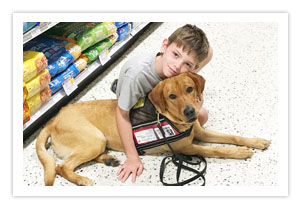
A boy in a grey T-shirt kneeling on a store floor with his arm around a tan dog in a black service vest lying beside him.

Autism Service Dogs

What is autism? A condition disturbing perceptions and relationships: a disturbance in psychological development in which use of language, reaction to stimuli and interpretation of the world, and the formation of relationships are not fully established and follow unusual patterns.

Dogs have been proven to be an asset for children diagnosed with autism and their family. Autism service dogs provide a social bridge for children who are often secluded by others because of their behavior or lack of social interaction. A well trained autism service dog can also provide comfort as well as calm children who suffer. An autism assistance dog can change the lives of a family with a child who has been diagnosed with autism or autistic symptoms.

Trained to respond to these autistic symptoms

  • Impulsive running: dog will help retrieve and get child back to parent
  • Self harming behavior: dog will interrupt behavior and alert parent
  • Awakening at night: dog will bark to alert parents
  • Interpret mood swings: dog will crawl into child's lap to calm child
  • Interrupt social isolation: child tends to focus on dog companionship
  • Non-verbal child: child learns to give dog commands
  • PICA: dog will stop child from eating inappropriate items
  • Self stimulation: dog can interrupt behavior

The tasks above represent what an autism service dog is capable of performing. Each autism service dog is specifically trained to its owner's personal needs based on their medical condition, and may or may not include the tasks described above.

Other advantages of having an autism assistance dog

  • Increased social interaction: assistance dogs have proven to improve social skills and social interaction with children affected by autism. These dogs are naturally interesting, which often draws the attention of the autistic child as well as others.
  • Redirecting repetitive behaviors: dogs can be taught to nudge a child that is performing repetitive behaviors. This touch is often all that is required to redirect the child from these behaviors.
  • Improved independence: assistance dogs can provide independence by allowing the child to walk with the dog as opposed to constantly holding the hand of a parent or adult. These highly skilled dogs can assist the child while under the direction of the adult.
  • Increased vocabulary: children with autism are often noticed to have an increase in vocabulary after being paired with an assistance dog. The children seem to be more comfortable in speaking with the dog, which transfers to more verbal interaction with people.
  • Improved quality of sleep: assistance dogs provide a certain level of comfort that can often improve a child's ability to sleep more throughout the night.
  • Overall calming ability: when performing everyday tasks, children feel less pressure working with a dog as opposed to their peers. The tactile experience of having a dog as a companion has also proven to provide calming effects.

Autism service dogs assist children and families with activities of daily living, while increasing the safety of the child and reducing the stress level of their family. Canines 4 Hope also refers to these dogs as autism assistance dogs and autism alert dogs.

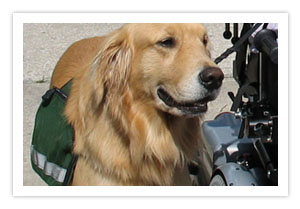
A golden retriever in a green working vest sitting beside the wheel of a power wheelchair on a paved path.

Wheelchair Assistance & Stability Assistance Dogs

Stability assistance dogs and wheelchair assistance dogs compensate for physical limitations by pulling wheelchairs, turning light switches on and off, and picking up dropped or needed items. A service dog can change your life and allows you the freedom to do things you never thought were possible.

Assistance dog work

  • Guide dogs: trained to maneuver visually impaired individuals around obstacles and across streets
  • Hearing dogs: alert the hearing impaired to sounds that might otherwise go undetected
  • Wheelchair assistance dogs: also provide emotional support for those in need

The tasks above represent what assistance dogs, wheelchair assistance dogs and stability assistance dogs are capable of performing. Each dog is specifically trained to its owner's personal needs based on their medical condition, and may or may not include the tasks described above.

Canines 4 Hope customizes your dog's training to fit your personal needs. You also have the freedom to take your service dog wherever you need to go: airplanes, restaurants, the supermarket, even in hospitals by your bedside.

Trained to the handler

Every list on this page is a list of examples

The tasks named in each program represent what a service dog is capable of performing. Each service dog is specifically trained to its owner's personal needs based on their medical condition, and may or may not include the tasks described.

Canines 4 Hope has been training service dogs for over 20 years and understands that every person has individual needs, so we create a customized training program for every service dog.

Hope Is Only A Phone Call Away

Canines 4 Hope, Palm City, Florida

Response, alert and everyday help

Dogs trained to respond, alert, and carry the load

Early warning work and everyday help are trained the same way as the specialties above: task by task, around one handler.

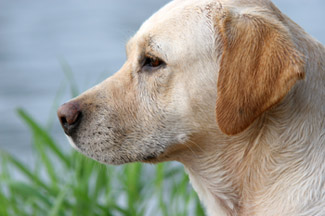
Close profile of a yellow Labrador standing in grass beside water.

Seizure Response Dogs

Seizure response dogs are trained to respond and help someone who has epilepsy or a seizure disorder. A trained dog could save the life of an adult or child with a seizure disorder, while giving a care giver the security of knowing that another set of caring eyes is focused on that seizure prone child or adult.

A seizure response dog can

  • Summon help, either by finding another person or activating a medical alert or pre-programmed phone
  • Pull objects away from the person's body that may be potentially dangerous
  • Block the individual with absence seizures and complex partial seizures from walking into obstacles, streets, and other dangerous areas that can result in bodily injury or death
  • Attempt to rouse the unconscious handler during or after a seizure
  • Provide physical support and emotional support
  • Carry information regarding the dog, the handler's medical condition, instructions for first responders, emergency medication, and oxygen
  • Sense an impending seizure and alert their handler or care taker

The tasks above represent what a seizure service dog is capable of performing. Each seizure dog is specifically trained to its owner's personal needs based on their medical condition, and may or may not include the tasks described above.

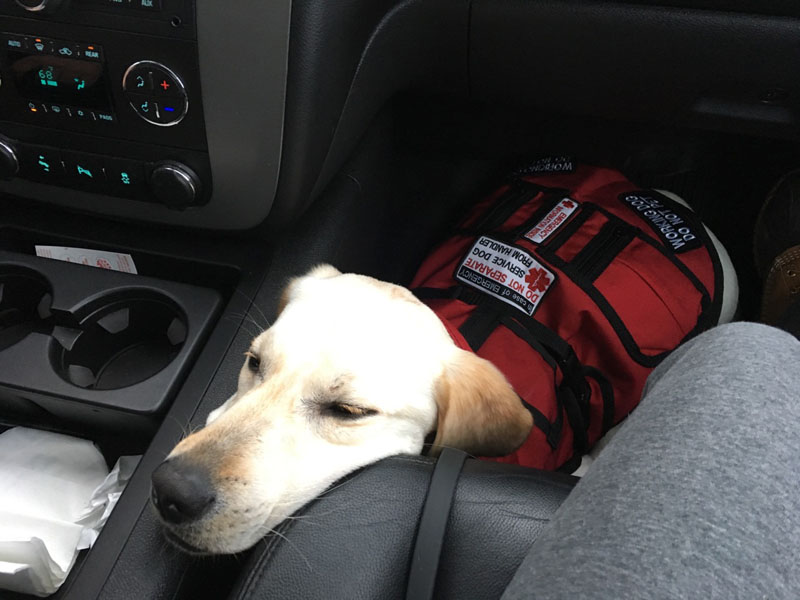
A yellow dog in a red vest patched Working Dog, Do Not Pet rests its head on a car console next to the person sitting beside it.

Medical Alert Dogs

Medical alert dogs are trained to recognize and respond to blood sugar fluctuations in diabetic patients, seizures and panic attacks. A well trained alert service dog is trained to assist and alert, helping individuals to live a normal life and giving their handlers the sense of independence they deserve.

A trained alert dog can

  • Retrieve medication and other items
  • Open doors and cabinets
  • Pick up phone
  • Alert authorities
  • Turn on and off lights
  • Alert owner to seizures
  • Alert owner to changes in blood sugar
  • Assist with walking
  • Alert owner to sounds (doorbell, phone, etc)
  • Provide companionship

The tasks above represent what an alert service dog is capable of performing. Each alert dog is specifically trained to its owner's personal needs based on their medical condition, and may or may not include the tasks described above.

Customized alert dog training programs

The cost of an alert dog depends upon the handler's medical needs and the number of tasks the service dog will need to alert its handler to, so the price is based on the difficulty and the number of tasks the dog must be trained to complete.

Next steps

Where to go from here

Service dog training and alert dog training are available to clients throughout the United States, from Palm City, Florida to any state.

What does a service dog cost?

Canines 4 Hope trains service dogs to each handler's specific medical needs, so training is extensive and costs vary depending on your needs. Call and a trainer will discuss what specific tasks would be required.

There is hope!

Tell us about the person the dog is for, and a Canines 4 Hope trainer will talk through the tasks that would make the difference. Pre-trained dogs can be tailor trained to your specific needs in 3 to 6 months.

Hope Is Only A Phone Call Away